
Niko earned his first AKC Rally Obedience leg this weekend. This is the first time we trialed in AKC events, and second time in Rally Obedience. I started to trial with him one and half years ago. We started in NACSW, went from Odor Recognition Tests (ORTs) to NW1, NW2, and element trials. We also trialed in Performance Scent Dogs (PSD) trials and Wag it Games scent trials, and earlier this year, we started to trial in World Cynosport Rally Trial and then the AKC Rally this week.
Among all dog sports, nosework is most reactive-dog friendly because one dog searches at a time. And among all the venues, NASCW is the most reactive-dog friendly. At each NASCW trial I went to, competitors were told at the briefing to treat each dog as a reactive dog, giving each dog at least 8 feet of distance. I can’t recommend nosework enough to reactive and fearful dogs. It’s the best confidence boosting exercise for them.
But it’s not as easy to trial with a reactive dog in other venues, especially in Rally. In Rally events, most dogs will need to be crated or wait outside the ring. You have to walk past these dogs to get into the ring and your dog needs to focus on you during the run, with dogs and people standing outside the ring. As a reactive dog owner, I get nervous walking Niko in the neighborhood, not to mention trialing with him. Over time, I have developed some strategies to help to ease my trial stress.
First, I always have low (or no) expectations of the trial result. I have found that if I mentally accept the worst case scenario, my trial anxiety is greatly reduced. I ask myself before each trial–and before each exam when I was at school–even if we NQ, so what? I will still enjoy some alone time with my dog and we can try again next time!
Another simple trick to reduce trial stress: I don’t tell anyone that I signed up. It’s inevitable to put pressure on myself and my dog if I keep thinking what other people are expecting. So I simply keep it to myself.
Second, I don’t compare myself and my dog with other teams. Admittedly, social media has made this very hard, especially because there are ribbon posts after every weekend. I am truly happy for each team’s achievements but it’s also hard to not wonder “are we not good enough?” Everyone loves ribbons after all. But every team has it’s own challenges, big or small. It bears repeating that every dog is different–every handler is different and thus each team is different.
It took me a whole year to be able to watch our first ORT video. It was a disaster. Niko was so stressed: he was panting, whining, and trying to get out of the room for a whole 3 minutes. I didn’t want to relive that moment because I felt bad for putting him in that situation. But one year later, when I was finally brave enough to watch the video, it made me appreciate how far we have come. I made this comparison video of his first ORT and NW1.
Niko’s change in nosework trials
Third, I use R+ techniques for myself too. When I just started reactive-dog training, one trainer told me that if Niko has even one reaction, he is not going to get better. I know now what she meant: don’t let your dog rehearse bad behaviors. But it’s impossible to keep a reactive dog reaction-free living in Washington D.C. I often felt suffocated by the guilt of failing Niko after he had reactions. So I started to use R+ for myself–I told myself at least three things that I did right, the things I would tell Niko or my clients, especially when Niko had a bad day.
I do the same after each trial. I can always find at least three things to praise myself for–it could be as simple as remembering to bring the leash and treats to the trial (I forgot to bring our search leash to our NW1 so it’s a legitimate praise) or handling a stressful situation well. Each time I will think about what I did wrong and how we can improve, but not on the trial day. I do that after taking a few days off–humans need decompression time too.
Finally, I pay attention to Niko. Denise Fenzi recently wrote in her blog Five simple tricks for reducing trial stress how important it is to pay attention to your dog and his surroundings. I want to emphasize it because it is even more important for reactive dogs.
Niko is not a focused dog. So I have to put a lot of time and effort into improving his focus. If I want him to be focused, how can I not do the same? This doesn’t come naturally to me either. I was recently diagnosed with ADHD and I have been struggling with paying attention for 30 years. But if I can improve a dog’s focus through training, I can improve mine too. In each training session, besides timing, rate of reinforcements, and criteria, I also pay attention to my attention.
At trial, I don’t chat with other competitors because I want to devote all of my attention to Niko. After some acclimation to the environment, we will stay in the car, listen to music and relax. When we are waiting for our runs, I stay connected with him by talking to him and petting him. Below is my favorite trial photo. I love it so much because it’s a perfect representation of our connection at trials.
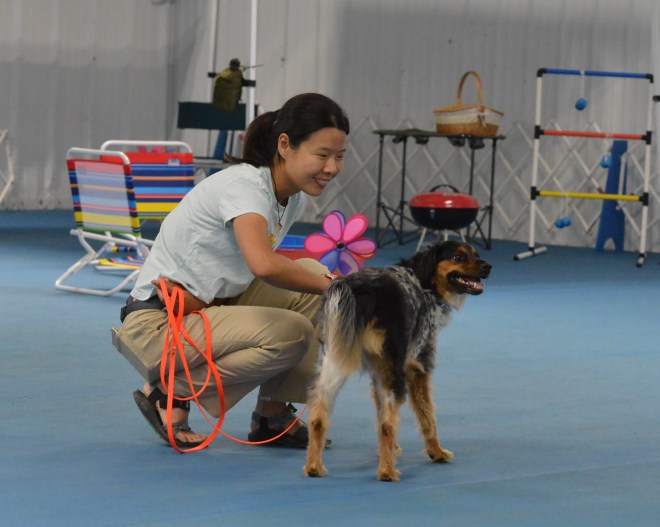
I love dog sports because I love training and competing, but they can also be very stressful–for both the handler and the dog. I will write my tips on managing Niko’s trial stress in another blog post. Each handler and each dog is different. These tips have worked for me, but may not work for you. I hope they have at least inspired you to find your own strategies for reducing trial stress.
 Dogtor Linlin