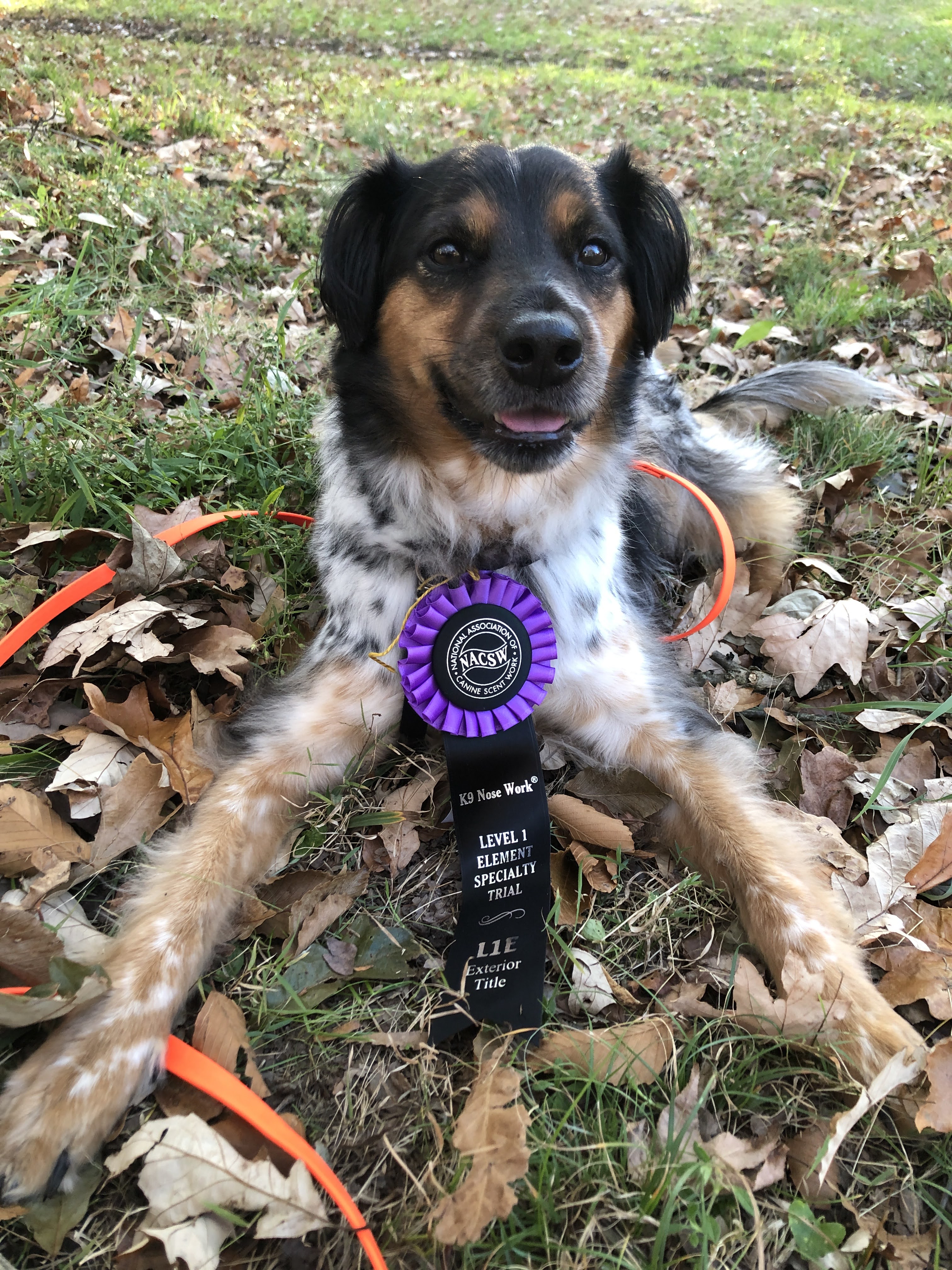
Most of us probably agree or have heard that nosework is one of the best activities when it comes to boosting dogs’ confidence. It’s known as the sport for reactive, fearful and sensitive dogs. There isn’t a lot of research in this area yet. This paper was published early 2019. I think the methodology in this study could be improved but I was very excited to see it has drawn the attention of researchers.
I use nosework as a behavior modification tool with my own dog and clients’ dogs. It is my go-to tool when working with fearful dogs because it is very effective improving dogs’ confidence. So I often think about why nosework works so well. Here are my non-scientific theories:
Confidence is the the belief that you can meet your challenges and succeed. Confidence is essential for perseverance when things get hard. Think about your latest life challenge. Maybe a public speech, teaching a class, going to a trial, preparing a family dinner, or speaking up to your boss. These challenges can be just difficult enough to give you the motivation to get out of your comfort zone and work for it; but not too hard that you don’t know how to start and thus become more frustrated and self-doubting. When you successfully conquer the challenge because of your hard work, you feel great about yourself. So next time you meet a similar challenge, you feel a little more confident in yourself. I call these challenges “good challenges.”
I think dogs experience challenges similarly. In nosework, each search is a scent puzzle. As a handler, our job is to set up the searches as good challenges—just challenging enough that the dog has to work for it; but so hard as to make the dog frustrated. If the puzzle is too easy, I think it can still improve the dog’s mood, but it doesn’t help much with the dog’s belief that he or she can conquer the challenge. If the puzzle is too hard, it will reinforce the dog’s fear that he or she can’t meet the challenge. When a dog finds the hides in these good challenges, the dog feels an amazing sense of accomplishment, and builds confidence.
Another piece is the freedom a dog has to solve the puzzles independently in nosework. Compared to other popular dog sports, nosework is different–the dog does all the work and the handler stands there and rewards the dog. Of course, nosework is also a great team-work sport because the handler needs to set up these good challenges and read their canine teammate. Nosework encourages independence in dogs–in nosework training, the last thing you want to do is to teach a dog to rely on the handler. When a dog is searching, he or she needs to find the hides independently, which involves assessing the environment, finding the scent cone, following the scent, using their past experience, tracing back to the hide and communicating with the handler. It is no exaggeration to say that a dog needs to make dozens of decisions independently in each search. So of course the dog will feel very empowered and great after finding the hides!
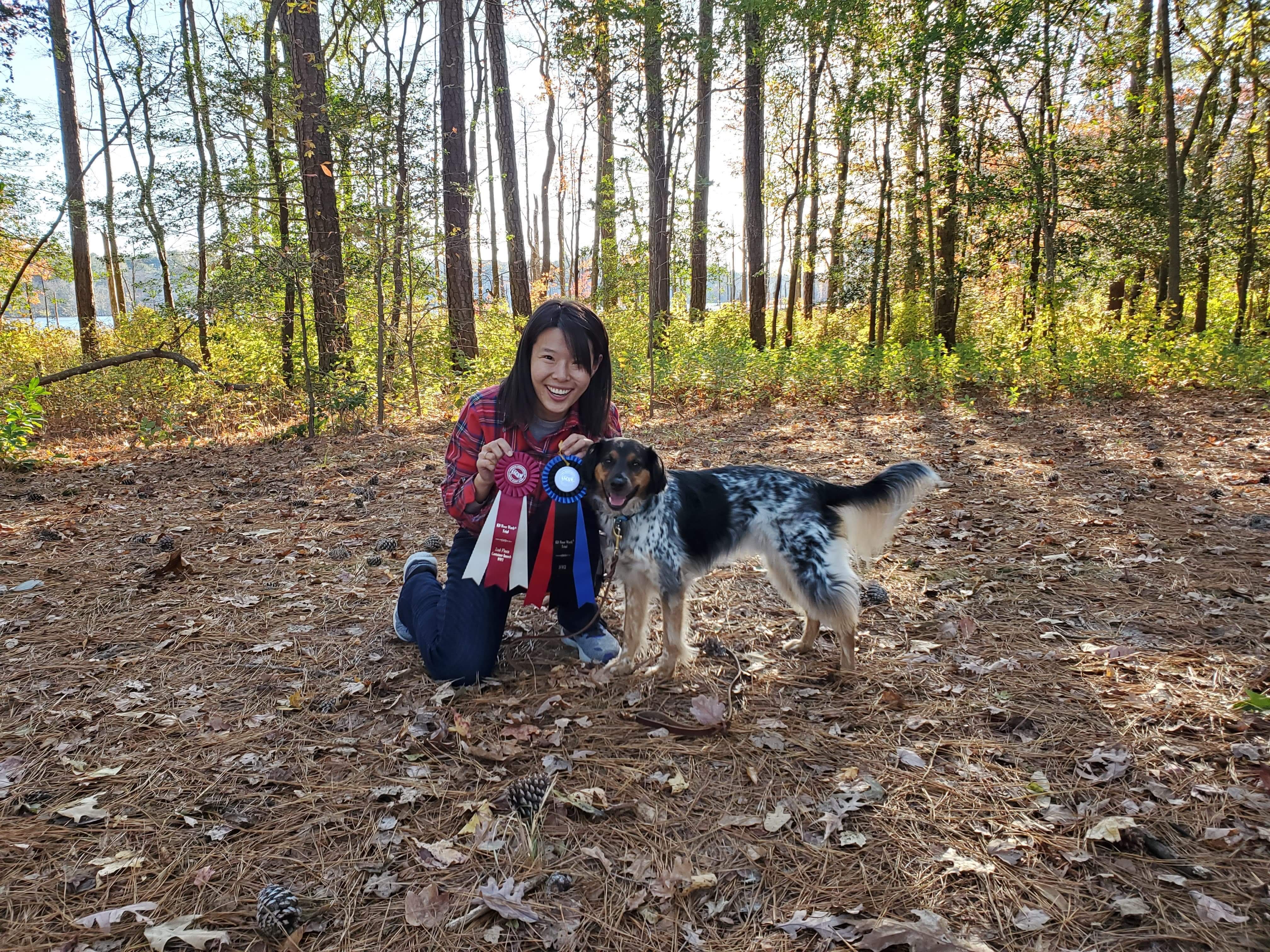
There is classical conditioning happening too because Pavlov is always on your shoulder. If you met my dog Niko two years ago, you probably wouldn’t believe he is the same dog you see at nosework trials now. Now he is happy and excited to go to trials; he is also quick and confident in searches and we have even started to get placements in some searches. But two years ago, we could barely leave our neighborhood because he couldn’t stop shaking and whining when we were outside. I did a lot of acclimation training with him but I think nosework has helped the most. Because he loves nosework so much, when he learned that he could search in a novel environment, it was very empowering for him. He started to associate that good and confident feeling with the environment, and everything started to seem less scary! Of course, we took it very slow so he wouldn’t get scared and reinforce his fear about novel environments or nosework.
Recently, I started my own confidence boosting exercise: sewing. Earlier this year, I wanted to make dog pajamas for my labrador Sunny. Sunny had elbow dysplasia and had surgery last winter. He has some slight arthritis at the time of his surgery already. So he can be a little stiff on cold winter mornings. I bought dog pajamas last winter but I didn’t like the fabric or the fit. So I decided to make my own this year. I ran into a lot of challenges in the process: from learning about thread tensions, how to use a zipper foot, and understanding the right and wrong sides of fabric, interfacing, to how to sew sleeves together, install zippers, prevent fabric from sliding, etc. Each time I successfully “conquer” a new challenge, I feel more confident in myself. After finishing one project I pick another project based on my skill level and interest. With each project, I run into different challenges and I figure them out. Every time I solve the challenge, I feel a little more confident. In the past 3 months, I have made dog pajamas, dog collars, human pajamas, clothes, and a crossbody bag. I want to eventually design my own clothes. I don’t have to get there fast but I believe I can succeed one day!
What are the good challenges for you and your dogs?
 Dogtor Linlin