
I just got back from a great walk with Niko. Today is one of the nicest Saturdays. We had snow last week but today is a perfect spring day: 56F with beautiful sunshine and breeze. We went to a park/trail near our house. Unsurprisingly, it was busy. We saw scooters, a skateboarder, 8 dogs within 10-30ft, and kids playing soccer on the grass.
We did some counter conditioning (CC) and behavior adjustment training (BAT). But most of the time, I just let him look until he decided it’s safe and then we carried on our walk. I enjoyed the walk as much as he did because I didn’t need to constantly look out as I know he can make the right choice in these situations.
Recently, I have seen many people using aversive methods, prong collar, e-collar, etc., in reactive dog training. I don’t want to talk about how they hurt the dogs; I want to discuss from a training effectiveness perspective. After all, if it’s not the most effective method, why do we use it?
When it comes to reactive dog training, handlers have two toolboxes: management and training. Management, in my understanding, involves the handler making the choice for the dog. It doesn’t actively change the dog’s emotions but management helps to reduce reactive frequency to prevent trigger stacking and rehearsal of the unwanted behavior. Training, on the other hand, involves the dog making the decisions. As a handler, our job is to make sure the dog makes the right decision.
From this perspective, aversive training method is management. Aversive tools give owners better control of their dogs. Correction can get the dog’s attention so they disengage from the trigger and focus on the handler. But the dog doesn’t make the choice; the handler makes the choice for the dog. This is the most important reason why I think aversive methods don’t work in the long term—management can fail. We don’t live in a vacuum and it’s impossible to manage our dogs 100% of the time. If so, we wouldn’t have reactive problems at all. I don’t want to micromanage my dog forever. I want my dog to know HOW to make the right decision.
I am a cross-over trainer. I used prong and e-collars for 4 months when Niko’s reactivity just started to show. I have to say, it worked wonderfully in the beginning. The first day I put a prong collar on him, we walked through the busiest streets and he acted normal and happy. I thought I found the solution and I still remember my excitement that day. I was wondering why everyone didn’t use this magic equipment?! I was very happy with it until 4 months later, when his anxiety was too high to hold back. All his problems re-surfaced again with much higher intensity. He couldn’t stop barking at guests even though they were in a different room; he barked at dogs two blocks away when we could barely see them; he barked at every person we encountered on walks; he barked at scooters, skateboards, motorcycles, bikes, buses, cars, etc. His confidence was totally ruined. That’s when I put all the aversive tools away and started to look into positive training.
I follow LIMA (least intrusive, minimally aversive) training philosophy and I won’t say I will never use aversion in dog training. But I don’t think aversive methods are good for reactive dogs. Why? Because science tells us that classical conditioning happens all the time, whether you like it or not (Pavlov is always on your shoulder). Dogs will associate the pain with triggers/the environment/sound/or anything. Some trainers will tell you that if you condition the correction with treats well, then this won’t happen. That’s simply not true. Pain is pain and that’s how aversive methods work. Punishment can never change emotions; it only suppresses the problem. The emotions will come back later or will show in other areas. Training helps us to change dog’s emotion towards triggers from negative to neutral, or even positive. But punishment will only make it more negative.
I have become a much better trainer since I stopped using aversive tools. I want Niko to make the right choice which means I need to understand thresholds very well and read dog body language like a pro. I need to notice the most subtle change in his body and know how to act on it fast. Because of this, I am proud to say that I am a good handler and trainer and I am helping other reactive dog owners every day.
Recent update on Niko: he is doing well! He does very well in neighborhood walks. Sometimes he can even handle other dogs barking at him. It doesn’t mean he is not reactive any more. He still has his moment but the frequency, intensity, and duration of his reactions are dramatically decreased. It also doesn’t mean I don’t manage him any more. Management is and will be part of our life. But the ratio of management is decreasing.
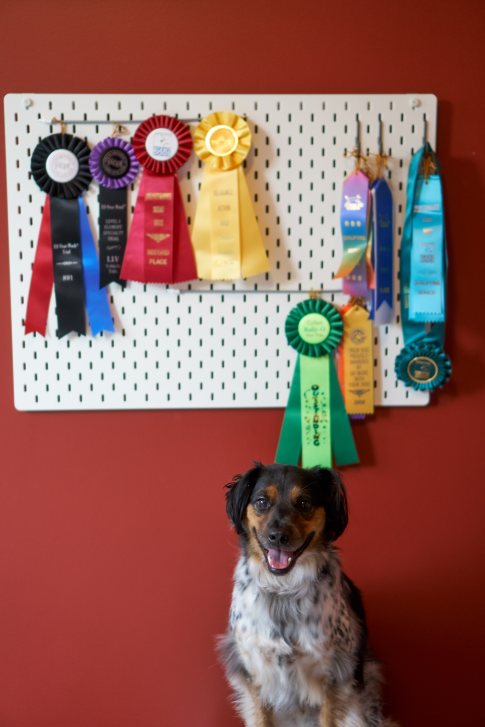
He also does very well in dog sports. We do nosework, cyber rally, and rally. One year ago, I wouldn’t believe that he could go to a real trial with so many dogs and people. But he constantly surprises me with how good he can be. His achievements in competition are impressive, but I am just as proud of him when we have a nice neighborhood walk. I don’t take anything for granted because I know how hard everything is for him.
Enjoy this photo of Niko with his ribbons.
 Dogtor Linlin
Thanks for posting. It’s great to read success stories. What breed(s)? He’s adorbs!
LikeLike
Thanks! He is a super mutt according to DNA test. Amstaff, cocker, dachshund and 5 more breeds.
LikeLike
I wish I could be so successful with mine. You know, throughout my entire career as a behavioral therapist I was GREAT at recognizing issues and suggesting solutions with my clients. The exact same learning methodology is what I need with my dog, why can’t I practice what I preached? I was fantastic helping parents and caregivers understand how to allow their loved ones choices, why do I bang into a brick wall when I try to do the same with my dog? It’s so frustrating, and I admit there have been times I considered aversive methods just because I needed some positive reinforcement of my own. It was only my knowledge of the temporary success such methods bring that stopped me. Someone else, in fact, many someone else’s, might not have that knowledge and out comes the shock collar or similar equipment. Even with my own failures with my dog, I try to educate others when I see that type of training. I pretty much look foolish since my own dog is lunging and barking at anyone in her line of sight.
Sigh. Rant over. Thank you for being a successful dog owner who can continue spreading more effective training methods.
LikeLike
Thank you for sharing! I know that feeling. It’s hard when there’s no clear instruction for ourselves like we give to clients. I found it’s a little easier when I have a goal. I am not goal driven by all means but with some goal in mind, I will work harder. That’s why I like competition.
LikeLike